The bill
Records the sale, the tax it carried and what the shop now owes, and takes the goods out of your godown at what they cost you — all in the same moment.

Part of Netolyst DMS
In Pakistan there is no Tally to hand your books to. So most distribution houses run a billing program all month and then rebuild the accounts by hand. Netolyst DMS keeps the books itself. Every bill, payment, expense and goods receipt writes its own accounting entry the moment you save it.
Everything on this page is part of Netolyst DMS — the same system that takes your salesman’s order, makes the bill, holds your godown and keeps the shop khata. There is no accounting-only version to buy. The books are not a module here: they are what the daily documents write as they are saved.
If you want to see the whole business and not only the money side, start with the full list of what it does and come back here for the accounting detail.
What it is
It means your books being written by the work itself — the bill, the payment, the goods receipt, the expense — so that on any day you can read real profit, real cash and a real balance sheet without anybody preparing them.
A distribution house has two sets of numbers that must agree. One is what each shop owes you, shop by shop. The other is what the business as a whole made, holds and owes. In most houses the first lives in a billing program and the second is rebuilt in a register or a spreadsheet every month, usually by one person, usually late.
When the second set is rebuilt by hand it is always behind and always arguable. You cannot tell on a Tuesday whether the month is profitable. You cannot tell how much of your money is sitting in the market. And when a bank asks for accounts, somebody spends a week assembling them.
Netolyst DMS removes the second job. The shop-by-shop side is covered under the customer ledger, and the document that starts most of these entries is covered under invoicing. This page is about the books of the business itself.
The problem
These are the everyday failures of running a distribution house on a billing program plus a separate set of books. None of them are unusual, and all of them come from the same cause.
The accounts are assembled after the month has closed. By the time you see a poor margin, the goods that caused it are sold and the next order is already placed.
The shop ledger says one thing and the accounts say another, because two people built them from the same bills at different times. Finding out which one is right takes days.
The bilty and the unloading are paid separately and written as an expense. So the goods look cheaper than they were, gross profit reads high, and the same freight is counted a second time further down the page.
A withdrawal is written as an expense, so a good day on which the owner took cash home reads as a poor one. After that happens twice, nobody believes the profit page.
Cash is counted at night and the difference is quietly absorbed — a little added here, a little ignored there. Nothing is recorded, so nothing can ever be explained.
Somebody spends a week building a balance sheet and a cash flow out of registers. The result is late, it does not tie to anything, and it has to be built again the next time.
The books
Every document that touches money writes its own double-entry record at the same moment it is saved. Not at night, not at month end, and not in a second program.
The shop khata stays the record you show a shop. That the khata and the accounts agree is something a report proves, rather than something you have to assume. The khata itself — payments spread across open bills, cheques, advances and the aging list — is covered under customer ledger and credit control.
Cash and bank
Money here is never a floating figure. It is in a drawer you named or a bank account you named, and every movement says which one.
| Where money sits | What you get |
|---|---|
| Cash point | A named place real cash sits — your counter drawer, the petty tin, the seth’s pocket. Main Cash is ready from day one and can never be removed. A drawer still holding money cannot be closed either. |
| Bank account | One account of one firm, with its bank, title, number, branch and IBAN. Kept per firm, because two firms’ accounts are two different legal entities’ money. |
Expenses
Money going out is not all the same kind of money going out. Netolyst DMS keeps three kinds apart, because mixing them is what makes a profit figure wrong.
| Kind of payment | What it is | Where it lands |
|---|---|---|
| Running the business | Rent, salaries, electricity, fuel, repairs, and whatever else you add. Recorded against an expense category you manage. | Your profit and loss account. This is the only kind that reduces profit as an expense. |
| Paid on goods | Freight or unloading paid against a goods receipt after the fact. It can never exceed what that receipt put into the cost of the goods. | Stays out of the profit page, because those rupees already reached profit inside the cost of the goods. This is what stops freight being counted twice. |
| Taken by the owner | The seth’s own money leaving the business. | Owner’s capital, never expense. There is no path from it into your profit figure. |
Owner’s money
This is a small rule with a large effect. In most hand-kept books the owner’s withdrawal is written as an expense, so the night a seth takes cash home the day reads as a loss. After that, nobody trusts the page again.
Day close
A day close is one cash point, one day, counted and finished. It is the routine that makes tomorrow’s figure trustworthy.
opening float + cash in − cash out = expected counted − expected = difference
Your cashier types what was actually counted. The system already knows what should be there, and shows the difference with its sign.
Profit
Sales, minus what came back, minus what the goods truly cost you, is your gross profit. Then every cost on its own line, down to what the business actually made. It is added up from your documents, so it reads the same tomorrow as it does tonight.
Money you took out of the business appears nowhere on this page.
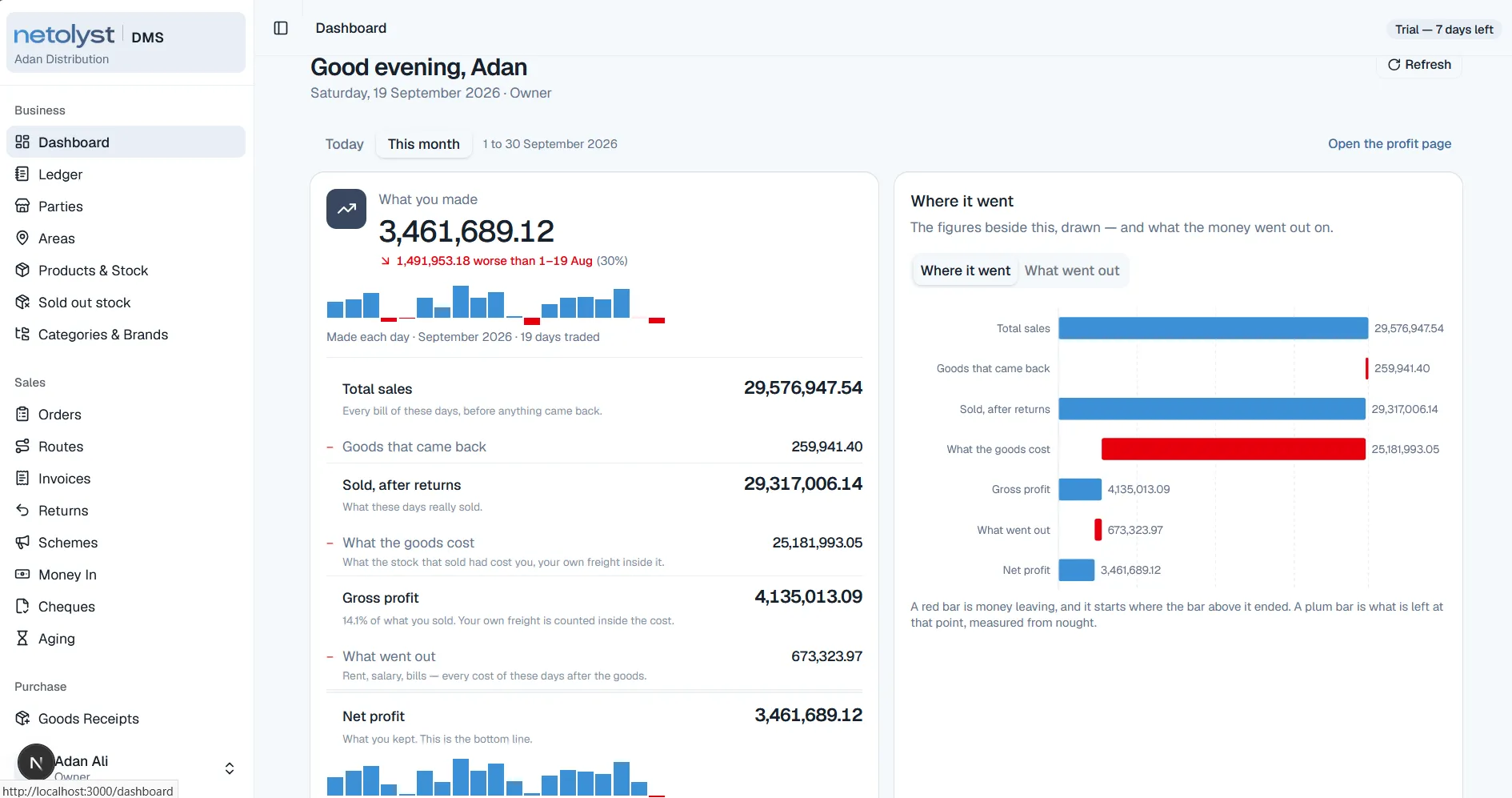
The cost figure on this page comes off the batch a bill sold from. How that cost is built, and why the same product can sit in your godown at three different costs, is covered under batch-wise inventory management.
Statements
These are the pages you hand to somebody outside the business — a bank, an auditor, a partner. All of them print as A4 and download as a real Excel file.
| Statement | What it tells you |
|---|---|
| Balance sheet | One day: what the business has, what it owes, and your share of it. It balances by construction, and every line sits on the side its balance actually runs. |
| Cash flow | A period. It ties to your cash and bank books, shows a transfer between your own accounts nowhere, and counts a cheque on the day it clears. |
| Profit and loss | The profit page above, laid out as a formal statement. |
| Linked accounts | The check that the statements say what their own books say. This is the report that makes the other three provable. |
Assets and loans
What a distribution house owns and owes sits in the same books as everything else, and it is recorded by a document rather than invented by the software.
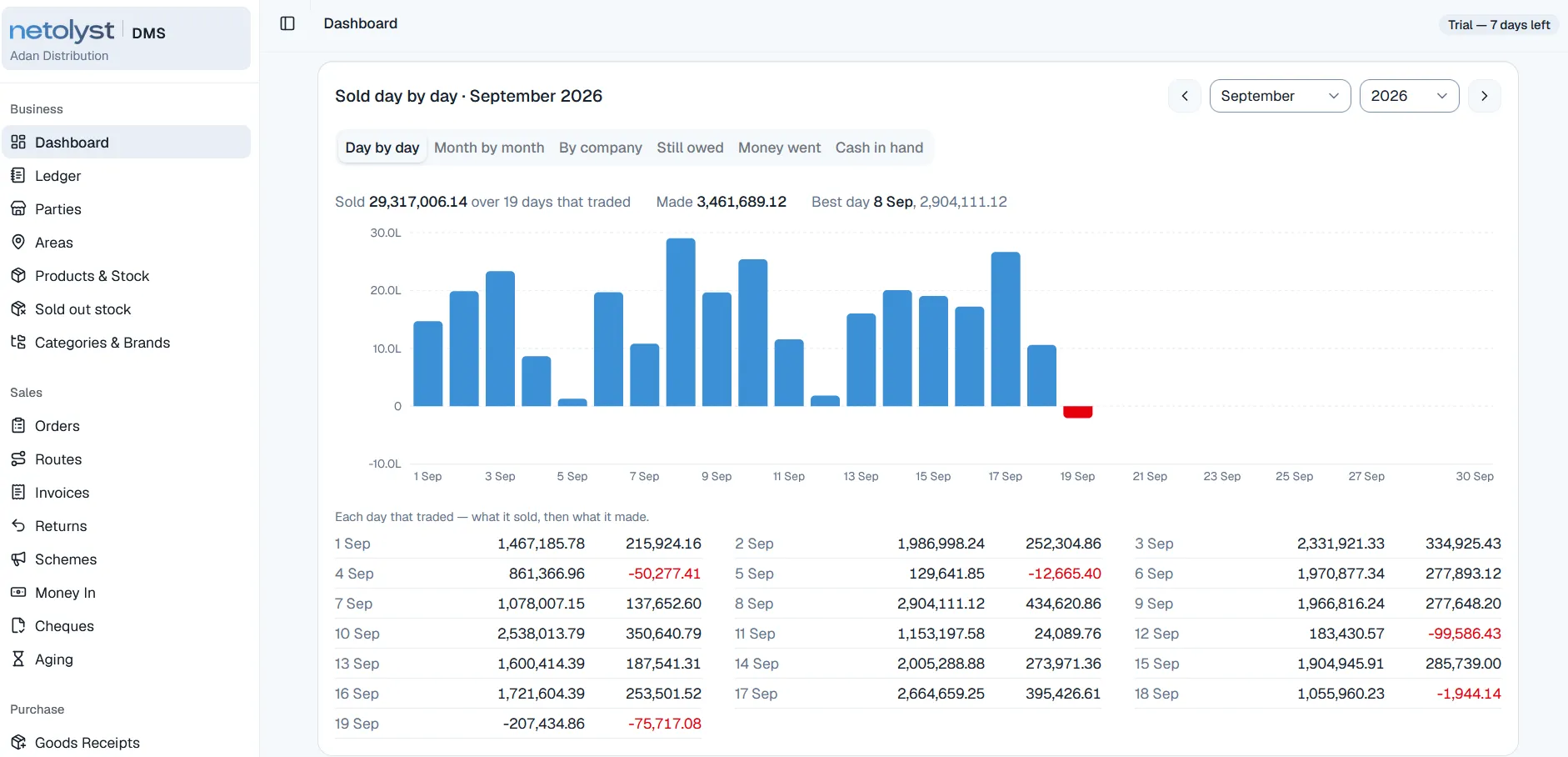
Reports
Pick a date range, tick what you want, and take the whole lot in one go: an Excel workbook with a tab for each report, and a print sheet your browser turns into a PDF.
The dashboard sits beside all of this with a Needs attention list: the things somebody has to act on today, each row opening the page that fixes it. You only see the rows you have the keys to open, and a row is simply absent when there is nothing to do.
Connected
Nothing on this page is a separate module somebody posts to. Each of these writes its accounting record itself, as part of the same save.
Records the sale, the tax it carried and what the shop now owes, and takes the goods out of your godown at what they cost you — all in the same moment.
Reduces what the shop owes and puts the money into a named drawer or bank account. A cheque reaches the bank book only when it clears.
Records what you owe the company and gives the batch its real cost, with your freight already inside it. That cost is what your gross profit is measured against.
Reverses the sale, credits the shop and brings the goods back, so your profit figure and your stock figure move together instead of separately.
Each of those four has more behind it: the bill, the payment and the khata, the goods receipt and the return.
Protection
Every one of these is a mistake a distribution house makes at least once a year with hand-kept books. Here none of them is possible.
The document and its entry are written together in one save. If one fails, neither is kept. There is no window where your books are behind your business.
The chart of accounts belongs to the software and nobody can edit it. What is yours to manage are your expense categories, your asset categories, your cash points and your bank accounts.
A cash or bank book can never go below zero. The payment is refused when it is made, not discovered when the month is closed.
Freight paid against a goods receipt goes into the cost of the goods and is capped at what that receipt actually carried. It cannot also land in the profit page as an expense.
Withdrawals are capital, not expense. There is no route from that account into the profit and loss statement.
Every difference is recorded with its sign and a reason, and a large one needs a second person. Nothing is hidden, and nothing is smoothed away.
Limits
The fastest way to waste your time and ours is a demo that ends on something the product was never built to do. Here are the boundaries, before a conversation instead of after one.
Pricing and the 14-day free trial are the same for every part of the product. They are explained on the Netolyst DMS pricing page.
Words
These are the terms this page uses and what each one means inside Netolyst DMS. Where trade and accounting use different words for the same thing, both are given.
It is the part of a distributor management system that keeps the books of the business itself, as opposed to the ledger of what each shop owes you. It records every bill, payment, expense, goods receipt and return as a double-entry accounting entry, and produces the profit and loss account, the balance sheet and the cash flow from those entries. In Netolyst DMS it is not a separate module anybody posts to: the documents your staff already make are the entries.
No. Every money document writes its own accounting entry as it is saved, so the profit page, the balance sheet and the cash flow come out of the same transactions that ran your business. Nothing is exported to an accounting package and nothing is retyped into one. There is also no integration with one, which is the other side of the same decision.
No, and they cannot. There is no voucher screen. The bill, the payment, the expense and the goods receipt are the entries. If a figure in the accounts is wrong, the document behind it is wrong, and that is where it is corrected.
Two ways, both built in. The system can rebuild the whole journal from your documents alone and compare it with what is stored, so a difference is something you can find rather than argue about. And one of the shipped reports exists only to check the statements against their own books.
No. It is set and owned by the software. What you do manage are the lists that genuinely differ between distribution houses: your expense categories, your fixed-asset categories, your cash points and your bank accounts. That split is deliberate. It keeps the statements comparable while leaving you the parts that are actually yours.
No. Money the owner takes out is treated as capital, not as an expense, and there is no path from that account into the profit and loss statement. In the cash book the line is hidden from people without the permission to see it, but it is never removed, so the drawer still adds up for whoever is counting it.
Your cashier types what was actually counted. The system already knows what should be there and shows the difference with its sign. A reason is always required, and above a limit you set a second person has to sign it off. It never blocks the close, and it is recorded as cash short or over so you can read it the next morning.
Yes. You can name as many cash points as you actually have, and as many bank accounts as your firms hold. Each keeps its own book with a running balance, none of them can go below zero, and moving money between them is a transfer document rather than an expense. Bank accounts are held per firm, because two firms’ accounts are two different legal entities’ money.
Yes. A term loan, a working-capital line or a running finance each sit in one account, and the part due within the year is separated from the long-term part when you read it, off the loan’s own schedule. What the bank charges you is recorded when its advice arrives rather than estimated in advance, and it prints as finance cost below operating profit.
Each statement prints in two versions side by side: your own plain one, and the one a bank expects, where a related account prints under its parent and the cash flow is laid out the indirect way. Where your financial year is cut is a setting. Everything prints as A4 and downloads as a real Excel workbook.
No. No return is prepared, nothing is submitted, and there is no FBR connection. Tax is charged and printed on your own invoice. Filing stays with your tax consultant. Purchase tax is also not reclaimed — it goes into the cost of the goods and into what you owe the company.
Freight and unloading paid on a load go into the cost of the batch that load created, not into your expenses. So your gross profit is measured against what the carton actually cost you, with your own freight inside it. Freight paid later against a posted goods receipt is capped at what that receipt carried and stays out of the profit page, which is what stops the same rupees being counted twice.
Only the people you give those keys to. Cost, margin, the accounts and the owner’s withdrawals are separate permissions, and none of them comes automatically with a job title. A counter clerk can make bills all day without ever seeing what a carton cost. Nobody can give somebody a permission they do not hold themselves, and everything anyone changes is written to a log that cannot be edited.
Yes. What was in each drawer and bank account on the day you start is the first line of that book and is then frozen. Party balances come in the same way, as the first line of each party’s book, from a CSV template. Stock comes in as ordinary goods receipts so that every batch has a real cost from day one. The cutover uses the same doors the daily work uses.
Talk to us
Who writes them, how long your month end takes, and what your bank asks you for. Your reply will come from the engineers who built the accounting, not from a sales desk.
Built for a Pakistani distribution house holding one to four dealerships, billing in rupees and keeping its own books. Not an audit tool, not payroll, and not a tax filing service.