Industry

Pharmaceutical distribution software for Pakistan

Batch and expiry are not an add-on here. They are how the stock is held. Netolyst DMS keeps every lot with its own batch number, its own expiry date and its own cost, keeps the medical store’s khata behind it, and keeps the books underneath. Some things a pharma distributor needs are not in it. Those are on this page too.

+92 336 0861999

ONE PRODUCT, THREE BATCHESBatch oneoldest — goes out firstBatch twoits own cost, its own priceBatch threeits own expiry dateTHE BILLLine 1 · from batch oneLine 2 · from batch twoEACH LINE, ITS OWN RATEEXPIRY WATCHED
One medicine, three lots. Each with its own batch, its own expiry date and its own cost.

Everything here is part of Netolyst DMS. There is no pharma-only version.

Everything on this page is part of Netolyst DMS — the same system that takes your booker’s order, makes the bill, keeps the medical store’s khata and writes your accounts. Batch and expiry are not a pharma add-on bolted onto it. They are how stock is held for every distributor who uses it, which is why this page can be honest about where the fit ends.

If you want to see the whole business and not only the pharma part, start with the full list of what it does and come back here.

Read this first

Decide in two minutes, not after a demo.

A pharma distributor should know the shape of this software before anybody books a meeting. So both halves are on the page, side by side, in plain words.

What fits

What fits pharma well

This is the part of the trade the product was actually built to hold: the lot, the date, the cost, and the money behind them.

  • Every lot carries its own batch and expiryA batch number, an expiry date, the cost you paid and the rate you sell at sit on each lot. Two consignments of the same medicine are two lots and are never averaged.
  • Expired stock cannot be soldNot a warning. Once a lot is past its date it cannot go on a bill.
  • You choose how early you are warnedThe warning window is set per product. Ninety days’ notice on one line and a shorter one on another is normal here, not a compromise.
  • The damage and expiry room is a real placeIt is a separate godown in the software, counted on its own, because the goods you send back to the company come out of it.
  • Batch and expiry print on the bill lineThe medical store is handed the batch and the date of the goods it is actually getting.
  • Credit, aging and recoveryBuilt for a trade that sells almost everything on credit and collects it store by store.
  • One statement per companyIn units and in rupees, for the principal’s man when he visits your office.

What does not

What is not in it

These six are not hidden in a limits section at the bottom. If one of them is a requirement you cannot move on, stop here.

  • Picking is oldest-received-first, not nearest-expiry-firstFIFO means the lot that arrived first goes out first. FEFO means the lot that expires first goes out first. This software does FIFO. That is Pakistani trade practice and it is the opposite of what a strict pharma operation wants. It is the single most important line on this page.
  • No DRAP handlingNo regulatory filing, no licence register, and no reporting to any authority.
  • No serialisation and no track-and-traceNo unit-level codes, no aggregation, and no scanning a pack back to a manufacturer’s serial number.
  • No recall workflowYou can find which bills carried a batch by reading the reports. There is no button that recalls a batch and works the list for you.
  • No narcotics or controlled-drug registerThere is nothing in the product for keeping a controlled-drug register.
  • No temperature or cold-chain recording of any kindNo temperature log, no cold-chain record, and no device reading anywhere in the product.

If any one of those six is a requirement you cannot move on, this is not the right software for you today, and we would rather say that here than at the end of a meeting. If what breaks your week is the khata, the aging, the expiry you found too late and the cost you cannot trust — read on.

The problem

The week this is built against.

A pharma distribution house in Pakistan runs on the same four disconnected books as any other distribution house, with one extra weight on top: every carton is on a clock.

  1. The same sale is written down four times

    The booker walks his round of medical stores with a diary. Orders come by phone and on WhatsApp. Somebody types the bill. By Thursday the copies disagree, and nobody can say which one is right.

  2. The store’s balance lives in a register

    What each medical store owes is in a book kept by hand. When the seth asks what the market owes him, the answer takes two days to build and is old by the time it arrives.

  3. The stock figure is whatever somebody counted last

    The godown total is a memory of the last counting. So the counter promises medicine you do not have, and holds back medicine you do have.

  4. A batch goes short-dated and nobody notices

    The batch number and the expiry are written on the carton, not in the system. The lot is found when it is worth nothing, and usually after the claim window on it has closed.

  5. A return cannot be traced to a batch

    A store hands a strip back and nobody can say which lot it came from. The return to the company then becomes an argument.

  6. The company’s man asks for his statement

    He arrives, inspects the expiry room, and asks for his stock and sale statement and his outstanding in the market. Somebody builds both from the bill book by hand.

The batch is the stock

Stock is not held per medicine. It is held per lot.

Stock sits per lot, per godown and per condition. Each lot carries its batch number, its expiry date, what it cost you and what it sells at. The same medicine received twice is two lots. They are never merged and never averaged.

  • Two consignments stay two costsThe price of a medicine moves between consignments. If your software averages your costs, your margin is a guess. Here each lot keeps the cost you actually paid.
  • Freight lands inside the costBilty and labour on the company bill are spread across the lines and go into the lot cost. So the profit page reads the real cost of the actual carton that sold.
  • The selling side refuses an expired lotOnce a lot passes its date it cannot go on a bill. It is still counted, still visible in your stock, and still worth arguing with the company about.
  • You set the warning window per medicineA line that needs ninety days’ notice gets ninety days’ notice. Near expiry is worked out from the date the moment you look, not held as a state somebody has to refresh.
  • The expiry room is counted apartSaleable, damaged, expired and quarantined goods are counted separately, in the godown they really sit in. A short-dated carton can never quietly raise what your counter is allowed to promise.
  • Cost and margin sit behind their own keysA counter clerk can bill all day and never see what a strip cost you.

How goods are received, moved between godowns, counted and valued is the same machinery every distributor uses. It has a page of its own. It is explained in full under batches and cost, and the near-expiry report sits with the rest of the stock reports.

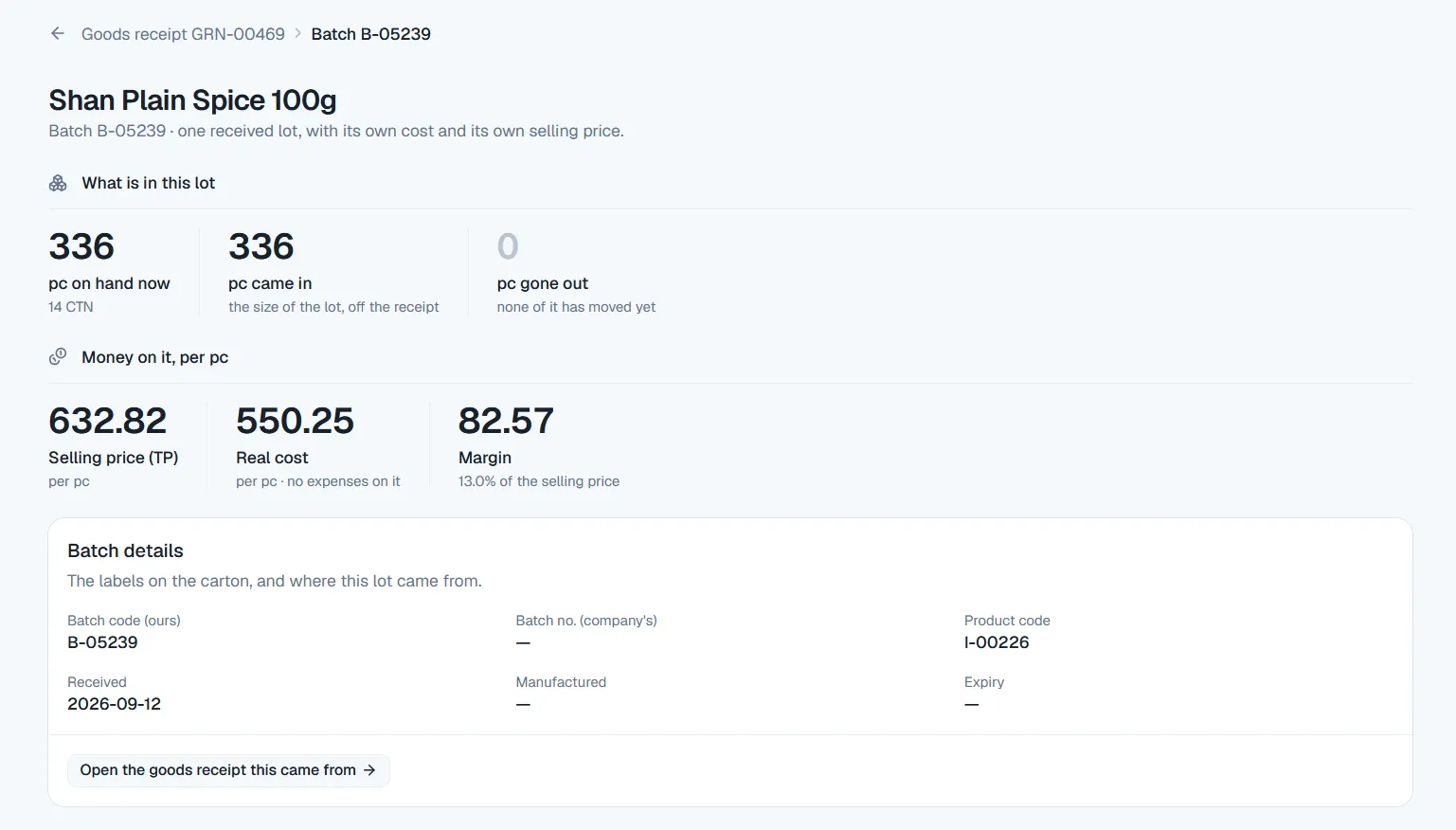
A lot detail screen in Netolyst DMS: pieces on hand, pieces received and pieces gone out for one lot of one product, its selling price, its real cost and its margin per piece with the margin as a percentage, and the lot details underneath — the batch code, the company’s own batch number, the product code and the dates — with a link back to the goods receipt the lot arrived on.
One lot · its batch, its expiry, its cost and its margin
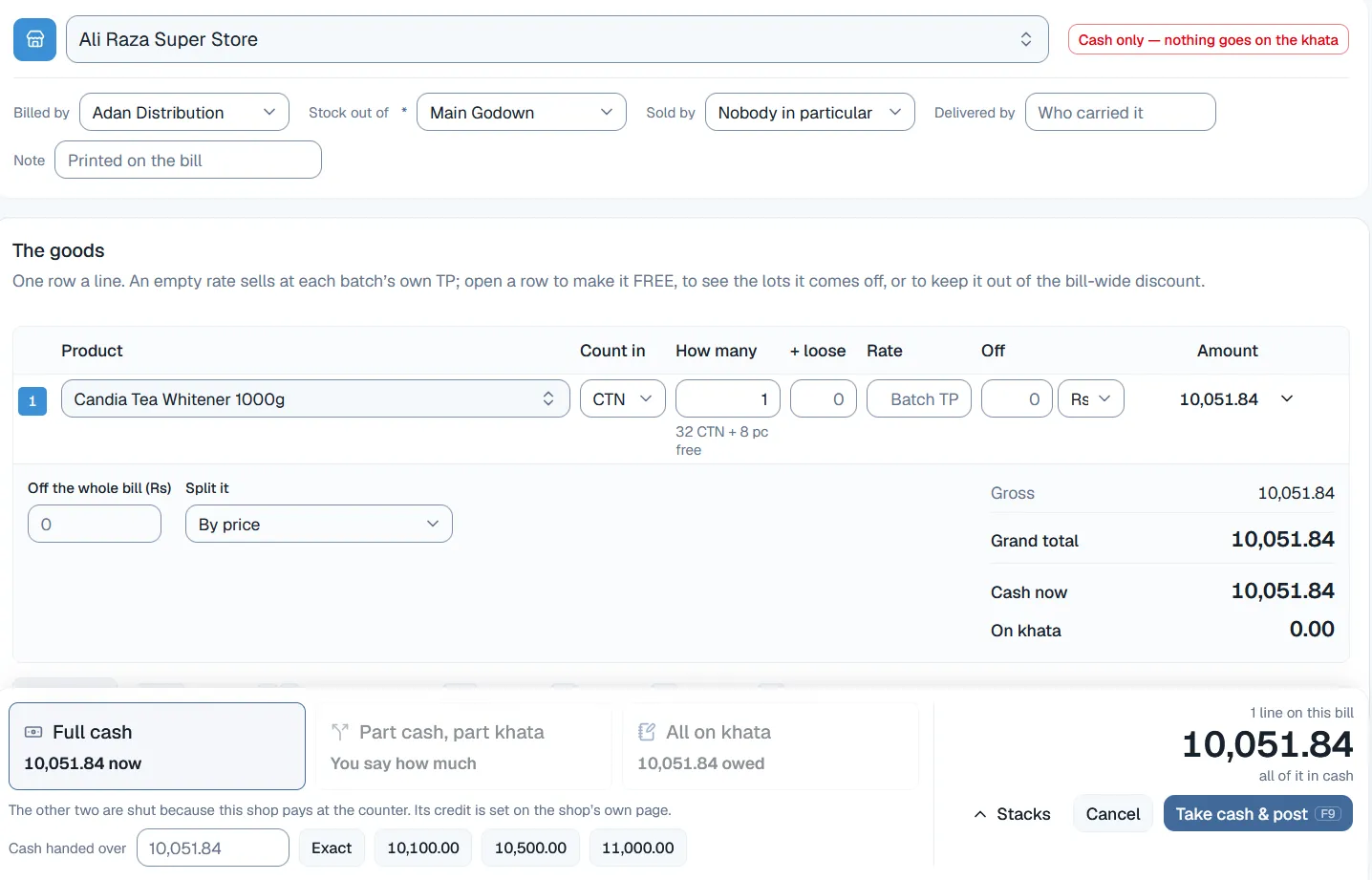
Making a bill in Netolyst DMS: the party is chosen at the top and carries a cash-only flag saying nothing goes on its khata, one product line is counted in cartons with its free pieces shown beside it, and the footer offers full cash, part cash and part khata, or the whole bill on khata, with the two credit choices greyed out for this party.
Making a bill · the line the medical store is handed

The bill

The store is handed the batch it is actually getting.

The bill line names the real batch and the real expiry of the goods in the bag. Nothing is rounded up to a product name, and nothing is left for the counter man to remember.

  • Twenty strips off two lots become two linesEach line carries its own batch number, its own expiry date and its own rate, because that is what is physically in the bag.
  • The oldest lot goes out firstPicking follows the arrival date, not the expiry date. Where the two differ, the near-expiry report is what tells you, and a person decides.
  • Sales tax withheld by a registered buyerWhere a registered buyer keeps back the sales tax and deposits it himself, that comes off what he actually pays without changing what the bill is worth. It is handled as what it is, not as a discount.
  • Free scheme goods come off real lotsA free carton leaves the godown from the same lot the paid ones came from, carrying the same batch and the same date.
  • A posted bill is never editedA wrong bill is voided with a reason and cut again. The void puts back exactly the lots the bill took and credits the store’s khata. The original stays standing.

The bill is cut at the office. There is no van sales or delivery module, so what your supplyman collects at the door is recorded when the bill is entered, not by an app in his hand. How a line is built, what the tax columns do and why a wrong bill is voided rather than edited are all on the invoicing page.

Returns

A return that names the lot it came from.

Returns are where a pharma distributor loses money quietly. Both directions are documents here, and both name the batch instead of guessing at it.

The return from the store is a sales document and is explained under sales returns. The return to the company hangs off the goods receipt it arrived on, which is covered under receiving goods.

Recovery

Most of the job is collecting it.

A pharma distributor sells almost everything on credit. So the khata behind the medical store matters as much as the stock in front of it.

The aging ladder, cheques, statements and the opening balances from your paper khata all have a page of their own. Start with the aging ladder, then the credit rules behind each store.

Example

Example: one batch of medicine, from the company bill to your books.

A worked example using documents that really exist in the product. Nothing is typed twice, and every step leaves the record the next step reads.

  1. 01

    The consignment arrives with the company bill

    Quantities, the company rate, your own selling rate, the tax columns printed on the paper and the bilty are entered as they read. The lot is created with its batch number and its expiry date.

    Storekeeper Goods receipt

  2. 02

    The lot now carries a real cost

    The freight is spread across the lines, so the cost on this lot is what the carton actually cost to land in your godown. The margin you see afterwards is the margin you earned.

    Nobody Automatic

  3. 03

    Your booker takes the order at a medical store

    He books it on a phone with no signal. The order holds no stock and carries no price — it is a request. It waits on the phone until he taps Send.

    Order booker Android app, offline

  4. 04

    The office accepts it and the stock is held

    Accepting the order picks the godown and reserves the stock at that moment, using the same check the counter uses. A phone that has been offline for four hours cannot know what is on the shelf, so it is never allowed to.

    Order desk Web app

  5. 05

    The bill takes from the oldest lot first

    Twenty strips come off two lots, so the bill carries two lines with two batch numbers, two expiry dates and two rates. That is what goes in the bag.

    Counter clerk Invoice

  6. 06

    The store pays a round figure a fortnight later

    It is spread across his open bills oldest first. Where he withheld the sales tax to deposit himself, that comes off what he hands over without changing what the bill is worth.

    Cashier Receipt

  7. 07

    Two strips come back short-dated

    A sales return credits the store’s khata against the same bill and the same lot, and the goods land in the expiry room instead of on the saleable shelf.

    Recovery staff and storekeeper Sales return

  8. 08

    The goods go back to the company

    A purchase return goes against the posted goods receipt and its exact batch, valued at the company’s own price. The company account moves with it.

    Storekeeper Purchase return

  9. 09

    The month closes without anybody rebuilding it

    The profit page, the aging ladder and each company’s stock and sale statement all come from the records these eight steps created.

    Nobody Reports

The carton counted off the truck in step one is the same carton on the bill in step five, the same rupees on the khata in step six, and the same line on the company’s statement at the end. Nobody enters it a second time, so nobody can enter it wrong.

Control

Who sees what, and who may change it.

In a trade where the cost is the argument and the credit is the risk, the keys matter as much as the screens.

Why a document is corrected rather than edited is a decision we have written down. It is on our principles page, and the bill side of it is under posting a bill.

Connected

The rest of the business is in the same system.

Batch and expiry are only half of a pharma distributor’s week. These are the other parts, and they all read the same records.

Orders from the round

Your booker carries his medical stores in walking order on an Android phone, with what each one owes, what each one bought last time, and the catalogue. It works with the data off. Orders wait on the phone until he taps Send, and every figure on his screen shows how old it is.

The bill

Batch-wise lines, the bill taxes, discounts that stay visible, free goods told apart from paid goods, and a void instead of an edit. Bills print on A4 under your own firm’s letters.

The medical store’s khata

A running account, round-figure payments spread over the open bills oldest first, cheques, statements, and the aging ladder your recovery staff work from.

The books

Every money document writes its own double-entry accounting as it posts. Nobody types a voucher and nothing is exported to a second program. Profit, the balance sheet and the cash flow read the same transactions.

Reports for the company’s man

47 reports over one date range, ticked by whoever is reading and leaving together as one Excel workbook and one print sheet. The per-company stock and sale statement, in units and in rupees, is one of them.

Each of those has a page of its own: the round and the order, the stock held lot by lot, the bill the medical store is handed, the khata it debits, and the books it writes into.

If you hold several companies’ agencies and most of your week is per-principal reporting, the FMCG distribution page goes into that. If expiry is your main worry and you also move food lines, the food distribution page goes deeper on warning windows and the damage room.

Limits

What this software does not do for pharma.

These were at the top of the page and they are here again in full, because a page that only says them once has half-said them.

Pricing and the 14-day free trial are the same for every part of the product. They are explained on the Netolyst DMS pricing page.

Terms

Trade words used on this page.

These are the words used above, in the meaning the product gives them.

Lot / batch
One received consignment of one product, with its own quantity, batch number, expiry date, cost and selling rate.
FIFO
Issuing the oldest received lot first. This is what this software does.
FEFO
Issuing the lot that expires soonest first. This is what this software does not do.
Near expiry
A lot inside its warning window. Worked out from the date when you look, not held as a state.
Godown
A store room where goods are stacked. Here it is a real place in the software, and the damage and expiry room is one of them.
Khata
A party’s running account, kept the way the paper register keeps it.
Aging
The receivables ladder: not due, 1–30, 31–60, 61–90 and over 90 days.
Medical store
The retail pharmacy your booker sells to. The shop at the end of the round.
Principal
The company whose agency you hold.
Stock and sale statement
The per-company statement a principal’s man asks for on a visit: opening plus received minus sold minus returned, in units and in rupees.
DRAP
The Drug Regulatory Authority of Pakistan. Nothing in this software files with it, reports to it, or keeps a register for it.
Withheld sales tax
Sales tax a registered buyer keeps back and deposits himself. It comes off what he pays you without changing what the bill is worth.

Frequently asked

Questions pharma distributors ask.

Ask us your own question
What is pharmaceutical distribution software?

It is the software a medicine distribution house runs its selling on: the stock in the godown held lot by lot with a batch number and an expiry date, the bill to each medical store, the credit account behind that store, and the books underneath. It covers what happens after goods leave the pharmaceutical company and before they reach the shelf of a retail pharmacy. In Pakistan that also means the booker’s round, the running khata, and the per-company statement the principal’s representative asks for on a visit.

Does every bill line show its batch and expiry?

Yes. Stock is held per lot, so a line carries the batch number and the expiry date of the actual goods going out. Where a quantity comes off two lots, it becomes two lines, each with its own batch, its own date and its own rate, because that is what the medical store is physically handed.

Can expired stock be sold by mistake?

No. Once a lot is past its date the selling side refuses it. It stays counted and visible in your stock, and it is still worth arguing with the company about, but it cannot go on a bill at any counter.

Is the picking FEFO, nearest expiry first?

No. It is FIFO, oldest received first. FIFO means the lot that arrived first goes out first; FEFO means the lot that expires first goes out first. This is the most important limitation on this page and it is deliberate, because it matches Pakistani trade practice. Expiry is still tracked on every lot and expired stock still cannot be sold, but where the arrival order and the expiry order differ, the near-expiry report is what tells you and a person decides. If your operation requires nearest-expiry-first picking, this software does not do it today.

Can I recall a batch?

There is no recall workflow. You can find which bills carried a batch through the reports, but the software will not build a recall list or work it for you.

Does it handle DRAP requirements, serialisation or track-and-trace?

No, none of the three. There is no regulatory layer in this product at all: no filing, no licence register, no unit-level codes, and no scanning a pack back to a manufacturer’s serial number. A pharma distributor should raise this before a demo rather than after one.

Does it record temperature or cold-chain conditions?

No. There is no temperature log, no cold-chain record and no device reading anywhere in the product. If you carry cold-chain lines and need those records kept in the same system, this is not the right software for you today.

How does it handle a return from a medical store?

Against the original bill and its exact lots, into the godown and condition you choose, with the store’s account credited the same way a payment would credit it. Goods going back to the company work the same way, against the company’s own posted goods receipt and its exact batches, valued at the company’s own price rather than at your cost.

How does it handle a buyer who withholds sales tax?

Where a registered buyer keeps back the sales tax and deposits it himself, that comes off what he actually pays you without changing what the bill is worth. It is treated as what it is rather than as a discount, so what you sold and what he still owes both stay correct.

How do I keep control of recovery from medical stores?

Each store carries a credit limit, a credit-days figure and a cap on how many bills may stay open, and a store can be marked cash-only until somebody with the right permission changes that with a reason. The receivables ladder runs not due, 1 to 30, 31 to 60, 61 to 90 and over 90 days, and it is built from what is left on each bill rather than from party totals, so a part-paid bill ages only its remainder. Overdue is worked out the moment you look at it.

I hold more than one pharmaceutical company’s agency. Are they kept separate?

Yes. The catalogue is partitioned by company, so the same medicine held under two agencies is two separate items with two separate stock positions. Goods can sit together in one godown physically while reporting separately, and each company can be handed its own stock and sale statement in units and in rupees, plus its own list of what is still outstanding in the market on bills that carried its goods.

Do I still need a separate accounting program?

No. The khata is in the product, and the accounting writes itself as each document posts. Nobody types a voucher and nothing is exported to a second program, so profit, the balance sheet and the cash flow all read the same transactions your bills and receipts created.

Who can see what a medicine cost me and what my margin is?

Only the people you give those keys to. Cost, margin and the owner’s own withdrawals are three separate permissions and none of them comes with seniority, so a counter clerk can bill all day without ever seeing what a strip cost. There are 53 named permissions across six roles with per-person exceptions on top, nobody can hand out a key they do not hold themselves, and there is an append-only record of who changed what that is never edited and never deleted.

What does it cost?

No price is published, because none is set. The shape is decided: one product with everything in it, priced in Pakistani rupees for a term you choose, with no tiers and no feature gating. A 14-day free trial exists and you can start it yourself. For a figure, talk to us.

Talk to us

Tell us the six limits do not break you.

We have written down what this software does not do for pharma because we would rather lose the meeting than lose it later. If batch, expiry, the khata and the aging are what you need, you will hear back from the people who built it.

Built for a distribution house in Pakistan billing in rupees. Not suitable today for an operation that requires nearest-expiry-first picking, serialisation, track-and-trace, a recall workflow, a controlled-drug register or cold-chain records.

Let’s connect