Invoicing
A posted bill debits the khata what the shop will actually hand over, which is not always the bill total. Voiding that bill credits the khata back and releases the money to spread again over whatever is still open.

Part of Netolyst DMS
Your shops do not pay bill by bill. A shopkeeper hands over a round figure and expects his balance to come down. Netolyst DMS keeps the khata that way, and does the work of tying that money to your bills underneath. You get the register your munshi already knows, and an aging list nobody could build by hand.
Everything on this page is part of Netolyst DMS, the same system that makes your bills, holds your godown and writes your accounts. There is no ledger-only version to buy. The khata cannot be a separate program here, because the bill is what debits it, the receipt is what credits it, and the journal entry behind both is written in the same moment.
If you would rather see the whole business first and the money side afterwards, read the full list of what it does and come back here for the khata detail.
What it is
It is one running money account per shop: what each bill put on it, what each payment took off it, what goods came back, and the balance after every row. From that one account come the two things a distributor actually needs — what the market owes him today, and how old each rupee of it is.
A distributor sells to hundreds of small shops, mostly on udhaar. The bill is only half the job. The other half is collecting, and collecting in this market does not happen bill by bill. Your man walks the route, a kiryana owner counts out twelve thousand rupees against a balance he half remembers, and everybody moves on. No bill number is named, and nobody expects one to be.
That is why the paper khata survived every billing program sold in Pakistan. It matches how the money actually arrives. What it cannot do is tell you which bills that twelve thousand cleared, which ones are still standing, how late they are, and which shop crossed the line you set for it three months ago.
Netolyst DMS keeps the khata the way your register keeps it, and works out the bills underneath for you. What a bill is worth, and what prints on it, belong to the bill itself and are covered under invoicing. What happens before the goods leave — the route, the order and the credit check at the counter — is covered under sales management.
The problem
A paper register records the balance honestly. What it cannot do is answer a question about it. Here is what that costs a distribution house, and why it happens.
Your register says a shop owes 84,000. It cannot say which bills that is, or whether any of them are four months old. The number you can read is not the number you need to act on.
Your collector decides at the shop door. Three months later the shopkeeper remembers a different bill. Two registers, two answers, and nobody can prove either.
The khata says the shop paid. The bank says nothing arrived. A cheque sits in the drawer undeposited and another one bounced quietly. Neither book alone shows you which.
No due date on the bill, no agreed days on the shop. A shop that stopped paying in June looks the same in the register as one that paid last week.
There is no limit written anywhere, so the decision to send more goods to a shop already deep in udhaar is made by whoever is standing at the counter that morning.
A shop closed two years ago and his balance is still sitting in what the market owes you. Your receivable figure is bigger than your money, and your profit last year was smaller than you were told.
How it works
This is the real sequence the product performs when a shop pays you. Your staff do step two. Everything after it happens on its own.
Twelve thousand rupees against a balance. He names no bill, because no shopkeeper thinks in bill numbers.
Pick the party, enter the amount, say whether it came as cash, a bank transfer or a cheque. That is the whole entry. It is dated the day the money was taken, not the day it was typed.
Cash goes into a named cash point. A transfer goes into one firm’s bank account. A cheque goes into neither yet, because the bank has not seen it.
Then the next, then the next, each capped at what it still owes. Nobody tags a bill and nobody can, so there is no wrong bill to tag.
Money that met no open bill sits on the party as credit and shows as a negative balance in his book. The next bill you make uses it up, oldest money first.
Carrying the balance after it, the way your paper register does. The row is never edited and never deleted.
Goods coming back travel the same path. A sales return credits the khata and reduces what that bill still owes, exactly the way the money in step four does. A payment and a return are one conversation, not two.
Going live
A distribution house switching over is not starting from zero. Every shop on your route already owes you something, and that figure has to come in without becoming a number somebody can quietly change later.
Your cash in hand, your bank balances and your stock come in through their own doors on the same morning. Cash and bank openings are the first line of their own books and are explained under accounting. Stock arrives as ordinary goods receipts, so every lot gets a real cost from day one — see how goods are received.
Taking money in
A receipt is money in from a party. Cash, a bank transfer, or a cheque. It lives on the party and never on one bill, because that is how it was handed over. What it clears underneath is worked out for you.
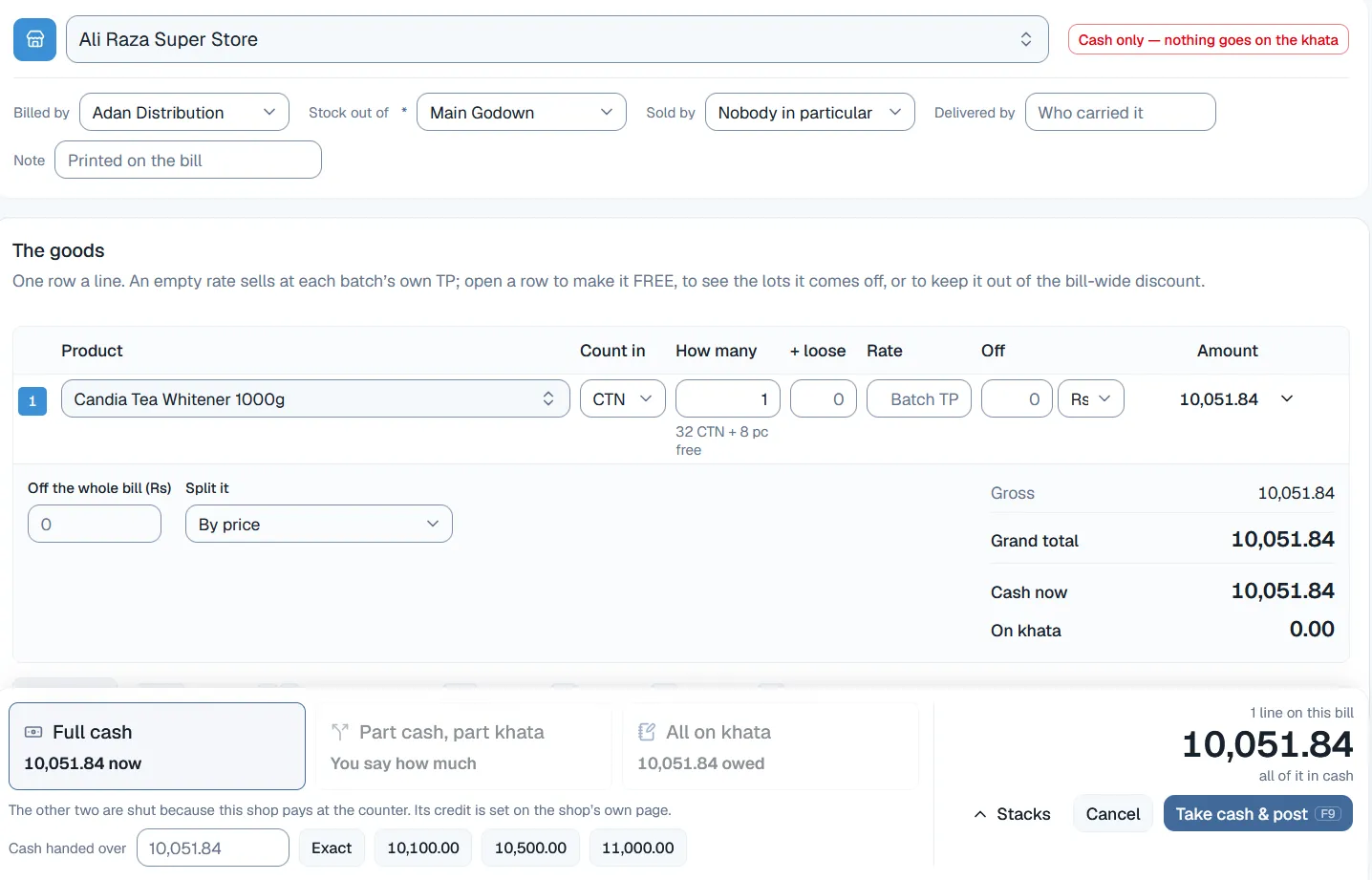
Cash customers
Not every sale goes on the khata. When a bill is settled at the time it is entered, the bill asks how, in three named ways: everything on khata, part cash and part khata, or full cash. What moves is a real payment against that one bill.
What is still standing
Two figures run this whole page. What one bill still owes, and what the whole party owes. Both are worked out from the documents every time you look at them, so neither can go stale.
open on a bill = bill total − money allocated − goods returned
what the party owes = every bill still open − money not yet allocated
Cheques
A cheque is not a payment that happens to be on paper. It is a promise, and it can still fail. The system follows it through four stages, and keeps your khata and your bank book honest about different things at the same time.
| Stage | What it means | What moves |
|---|---|---|
| Received | The shopkeeper has handed you the cheque. | The khata is credited that day, because that is the day he paid you. Your bank book does not move. |
| Deposited | The cheque has gone to the bank. | Nothing changes on the khata. Your bank book still does not move, because the bank has not paid yet. |
| Cleared | The bank has paid. | Your bank book counts it now. This is the only stage at which the money reaches your bank balance. |
| Bounced | The bank has refused it. A reason is required. | A debit goes on the same khata, beside the original credit. The credit is not deleted, so the record still shows what happened and when. |
Where a cleared cheque lands, and how one cash point is counted and closed at the end of a day against what was actually in the drawer, sit on the money side of the product. Both are covered under accounting.
Net receivable
A bill’s grand total is what the bill is worth. It is not always what the shop will pay. Where a registered buyer withholds sales tax and deposits it himself under his own name, that money never reaches you. So the system keeps a second figure beside the total.
what the shop hands over = bill grand total − sales tax he withheld
Which tax columns a bill carries, how each one is charged and what prints on the paper belong to the bill document itself. That is covered under invoicing.
Credit control
Every party starts cash only. Credit is something you grant, through its own permission, with a reason that stays on the record. Nobody inherits the right to grant it by being senior.
What happens at the counter when a shop fails its credit check is the selling side of the same rule. You can read it under credit control on the selling side.
Overdue and aging
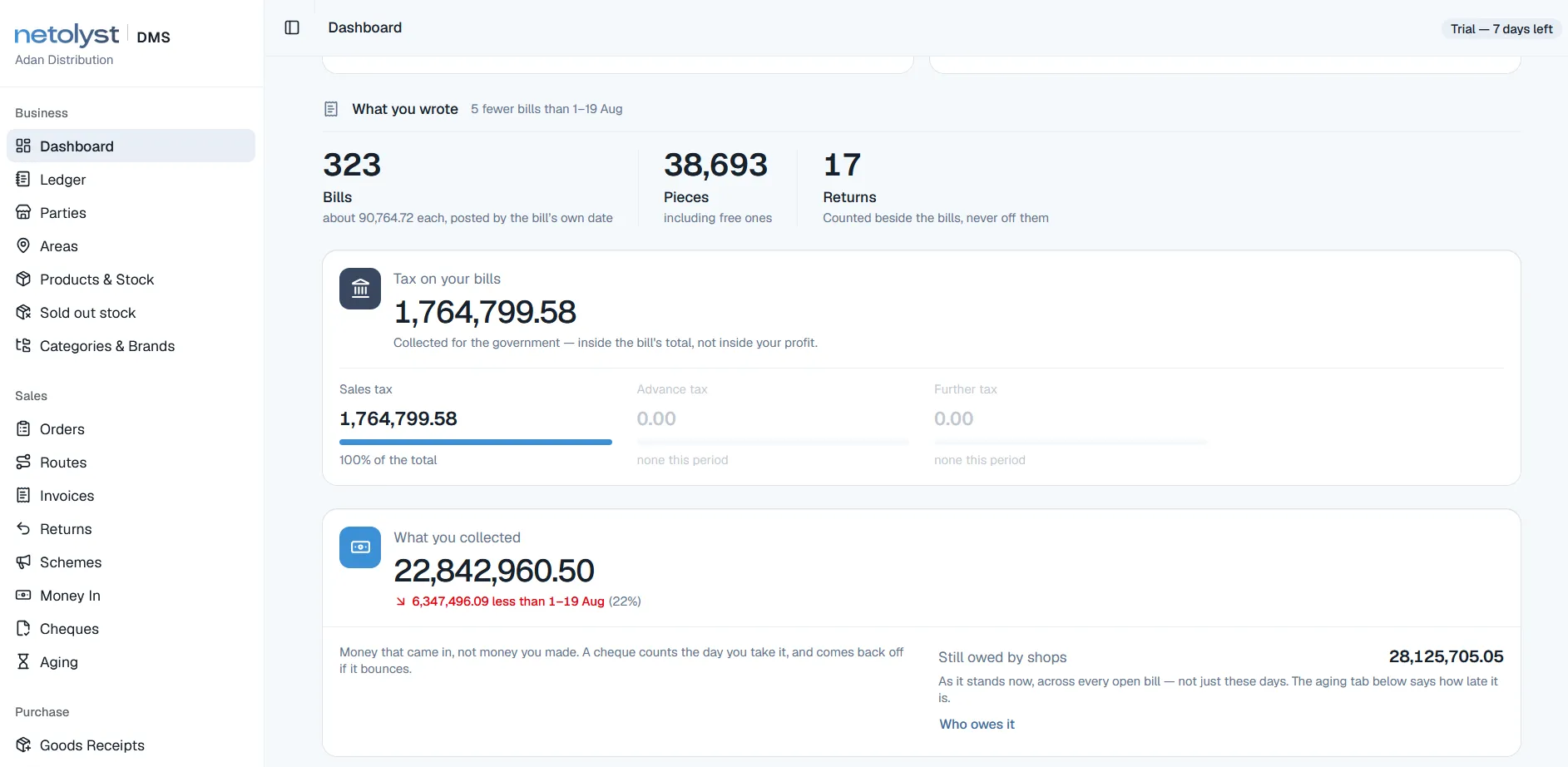
Nothing runs at night. Due dates, overdue and the whole aging ladder are worked out when you open the screen, from the bills themselves. So there is no job that can fail and no flag anybody has to refresh.
| Bucket | What sits in it |
|---|---|
| Not due yet | The day you agreed with the shop has not arrived. You are waiting, not chasing. |
| 1–30 days | Still unpaid up to one month after the due day. |
| 31–60 days | Still unpaid one to two months after the due day. |
| 61–90 days | Still unpaid two to three months after the due day. |
| 90+ days | Still unpaid more than three months after the due day. |
These are screens from the running product, captured on a demonstration business. The figures and company names in them are demonstration data, not a customer’s books. You can look at the rest of the real screens on the main product page.
Money going back out
Sometimes cash goes the other way. There are two reasons for it, and the difference between them is real, so the system writes two different documents. You press the same button. The party’s balance decides which one you get.
| Document | When you get it | How it behaves |
|---|---|---|
| Refund | The shop is sitting on credit with you and wants it back in cash. | Capped at the advance that has actually cleared, because handing cash against a cheque that can still bounce is the one way this loses you real money. It answers no bill, so nothing on the aging ladder moves. |
| Loan | You hand a shopkeeper cash that was never his. Money out past whatever credit he holds. | Written as a debit on his sales book. It ages like a bill and it uses up his credit limit, because money lent is money owed. |
Both need a reason, and neither can be voided. Your munshi does not choose between them and cannot get it wrong: if the shop has cleared credit with you, the money comes out of that first, and only what goes past it becomes a loan.
Write-offs
A write-off is a customer balance your house has decided it will not see again. Every distribution house has some. The question is whether the loss lands somewhere you can see it, or quietly eats last quarter’s sales figure.
Statements
Three printed pages come out of the khata. One for your shop, and two for the visitor nobody plans for — a principal’s area manager, who has no login in your system and never will.
The principal statement is summed off your stock ledger, so it is explained where the cartons are — under stock reports. Both pages also travel inside the report pack with the rest of your accounts, which is covered under accounting.
Connected
Nobody types a khata row here. Every row arrives because a document was posted somewhere else in the system, in the same moment it was posted. These are the four places the khata touches.
A posted bill debits the khata what the shop will actually hand over, which is not always the bill total. Voiding that bill credits the khata back and releases the money to spread again over whatever is still open.
The credit rule is checked before the goods leave, so a shop over his limit is caught at the counter and not at month end. A sales return credits the khata and settles that bill the same way a payment does.
Every receipt, refund, loan and write-off writes its own double-entry journal entry as it posts. Cash lands in a named cash point, a transfer in a firm’s bank account, a cleared cheque in the bank book, and a bad debt in the profit statement.
The aging ladder, the credit list and every party statement read off the same documents. There is no receivables figure anywhere that was calculated separately and could disagree.
Each of those four has its own page: the bill document, the selling side, the books underneath and the stock a bill takes from.
Protection
A warning message does not stop a mistake. What stops it is making the wrong thing impossible to do. These seven are built into how the khata works.
Nothing in the system edits a khata row or writes a balance. Every row is put there by a document and carries the balance after it.
Money fills the oldest open bill first, capped at what it still owes. Nobody picks a bill, so nobody can pick the wrong one.
The first line of a party’s book freezes the moment it is posted. What you brought over from your paper register on day one still reads the same a year later.
A cheque credits the shop’s khata the day you take it, and reaches your bank book only when it clears. The two books never pretend to be the same book.
Every party is cash only until somebody holding the credit permission changes that page, with a reason. It is not a checkbox at the counter.
Due dates, overdue and the aging ladder are worked out the moment you open them. There is no night job that can fail and no flag anybody forgot to refresh.
A write-off debits bad debts. The money you gave up on appears in your profit statement as a loss, and the bills it cleared stay exactly as they were issued.
Limits
The fastest way to waste your time and ours is a demonstration that ends on something the product was never built to do. Here are the boundaries of the khata, before a conversation instead of after one.
Pricing and the 14-day free trial are the same for every part of the product. Both are explained on the Netolyst DMS pricing section.
Terms
These are the trade words used above, in the meaning the product gives them.
It is the part of a distributor management system that keeps each shop’s running money account. Every bill puts money on it, every payment and every return takes money off it, and each row carries the balance after it. From that one account come the two things you actually need: what the market owes you today, and how old each rupee of it is. It is often called party ledger software or khata software, and it is the same thing.
No. The party khata is inside the product, and so are the books underneath it. A round-figure payment against no named bill is exactly what the system expects, and it spreads that money over the open bills oldest first. Nothing is exported to an accounting package and nothing is retyped into one. There is no link to any ERP or accounting program today, which is precisely why the ledger is held here.
Yes. Shops import from a CSV template, so the cutover is a morning rather than a month. Each party’s old balance comes in as line one of their book and freezes there, so nobody can quietly edit it afterwards. From that day it behaves like a bill: a payment spreads over it oldest first alongside everything that comes later. What you owe each company comes in the same way on the buying side.
The oldest open one, then the next, capped at what each one still owes. Your collector does not tag a bill and cannot. Choosing is where the arguments start, and three months later nobody can prove what was chosen. Whatever is left over after every open bill is filled sits on the party as an advance, and the next bill you make consumes it.
The extra becomes an advance. It shows as a negative balance in his book, which is how a paper khata shows it too. It is not a separate table or a special screen to balance at month end. The next bill you make for that shop uses it up, oldest money first. If he wants it back in cash instead, you write a refund, capped at the advance that has actually cleared.
The khata was credited the day you took the cheque, because that is the day the shopkeeper paid you. The bounce is a debit beside that credit, with a reason, like the scratch in a paper register. The original credit is not deleted, so the record still shows the cheque came and failed. Your bank book never counted it in the first place, because a cheque reaches the bank book only when it clears.
The bill stays worth its grand total, and the tax total on it does not move. What he will hand over is the grand total less the tax he withheld and deposited himself, and that lower figure is what his khata is debited and what the credit check judges. Withholding is his decision about paying, not a fourth tax on your bill. On every bill where nobody withheld anything, the two figures are equal.
Yes. Every party starts cash only, and credit is granted through its own permission with a reason on the record. For each shop you set a credit limit, the number of days you have agreed with him, and a cap on how many of his bills may stand open at once. Who may override any of those is a separate permission from who may sell, so your counter clerk cannot quietly overrule you in the middle of a sale.
Nothing runs overnight. A due date is the bill date plus that shop’s credit days, falling back to your house default where a shop has none of its own. Overdue means money still standing after the due day has passed, and the due day itself is still in time. Both are worked out the moment you open the screen rather than stored, so a bill that was paid is never shown as overdue however old it is. The ladder counts only what is still unpaid on each bill, so a 10,000 bill with 9,000 received shows 1,000.
Yes. Every party statement prints on A4 and downloads as a real Excel workbook, one per book. Numbers arrive as numbers rather than as text a spreadsheet has to guess at, and no cell can be read as a formula. A party who both buys from you and sells to you gets two separate statements, because the two books are never added together.
You write it off. It has its own permission and needs a reason on the record. It then behaves like a receipt that is not money: it spreads over that shop’s open bills oldest first and credits his sales book, so you can see exactly which bills it cleared. No invoice is touched and no cash book moves. The loss debits bad debts, so it shows in your profit statement instead of quietly shrinking a sales figure you already reported. A write-off cannot be undone.
No. The system sends no message to your customers at all. There is no SMS gateway, no WhatsApp connection and no payment link, and none is planned as a feature you can rely on today. What it gives you is an accurate list of who owes what and how late it is, so your own staff chase the right shops instead of all of them.
No. A party is closed, never deleted, so every bill, receipt and khata row it produced keeps the party it belongs to. A closed party stops appearing where you pick a shop, and its history stays readable. The same rule holds for users, godowns, products and routes in this product.
No. The khata is part of Netolyst DMS and is not sold separately, and that is a product decision rather than a pricing one. The bill is what debits the khata, the receipt is what credits it, and the journal entry behind both is written in the same moment. A ledger connected to nothing would send you back to typing the same figure twice, which is the problem this product exists to remove.
Talk to us
How many shops are on your books, what the market owes you at this moment, how much of it is more than ninety days old, and who decides that a shop has had enough credit. Your reply will come from the engineers who built the ledger, not from a sales desk.
Built for a Pakistani distribution house selling to kiryana shops on udhaar, collecting in round figures and keeping its books in rupees.