What is electronics distribution software?+
Electronics distribution software is the system an electronics distribution house uses to buy consignments, cost them, sell them to dealers on credit and keep the books that result. For a distributor in Pakistan that means holding the cost of each consignment separately instead of averaging it, putting duty, clearing and freight into the cost of the goods, keeping a running account for every dealer with a credit limit and an aging ladder, and writing double-entry accounts from the same documents. Netolyst DMS is a distributor management system used this way. It holds stock by consignment and not by individual piece, so it does not track serial numbers.
Can it track serial numbers or IMEI?+
No. Stock is held by consignment, not by individual piece. There is no serial-number or IMEI register, so you cannot record which serial went to which dealer and you cannot search a serial back to a bill. This is the first thing to check against your own business, and if serial numbers are a requirement then this software does not meet it today.
Can it handle warranty or repair jobs?+
No. There is no warranty record, no warranty period per unit and no claim register, and there is no repair, service or RMA module. A faulty piece can come back as an ordinary sales return into the damage room, and that is all. There are no job cards, no service status and no repair costing.
My cost changes with every consignment. Does the software average them?+
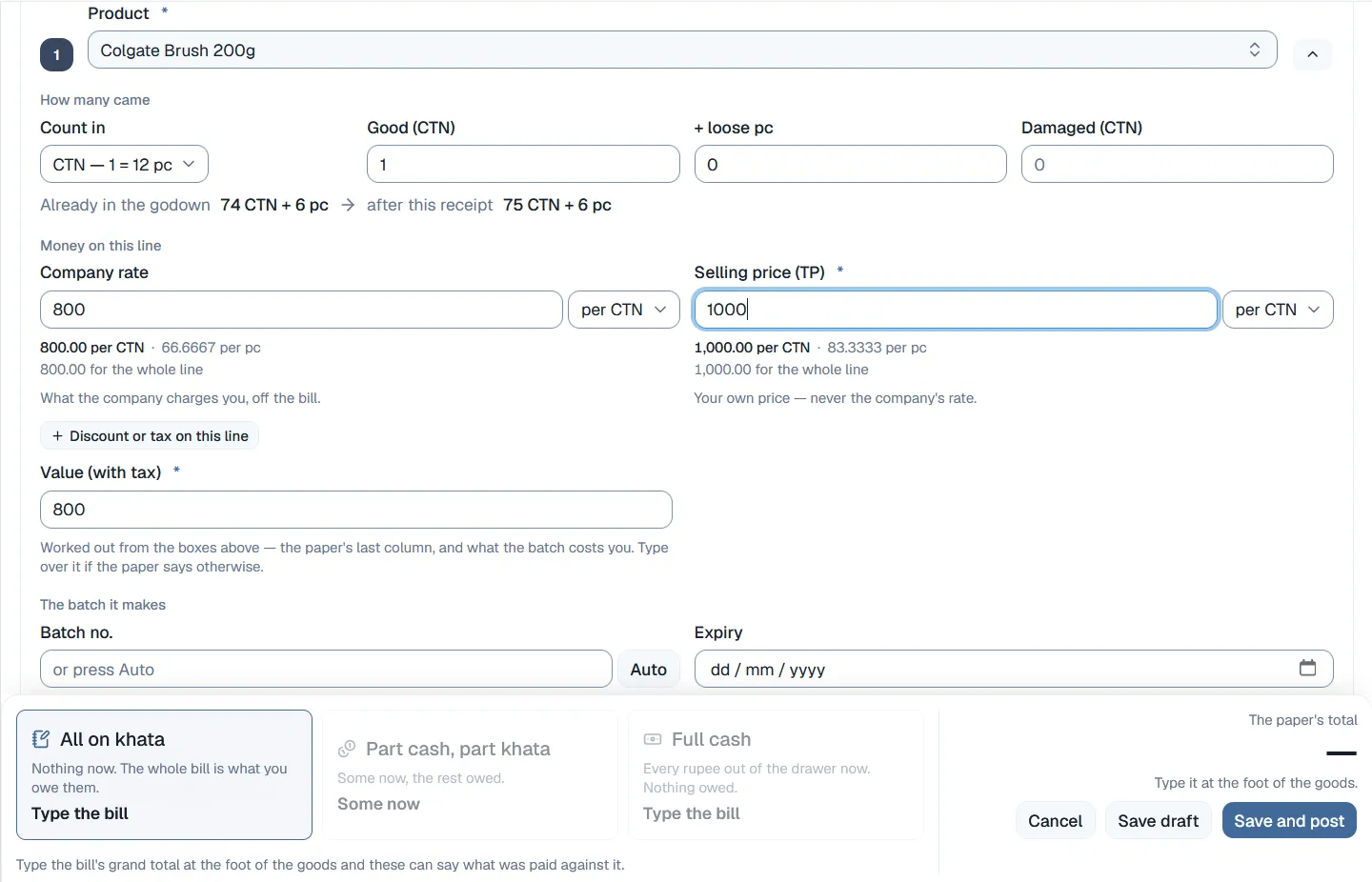
No, and that is the main reason this page exists. Each consignment is its own lot with its own cost and its own selling rate, and they are never blended into one figure. Freight, duty and clearing go into the cost of the goods on the receipt, so the margin you read is the real one rather than an average of your shelf.
Can I put duty and clearing into the cost of a consignment?+
Yes. Charges entered on a goods receipt are allocated into the cost of the lines — by value, equally, or by quantity. So the carton cost is the landed cost and not the supplier’s printed rate. The import paperwork itself is not managed here: there is no import, LC or customs module. What is handled is the money that changes your cost.
What happens when the price rises and I am still holding old stock?+
Each consignment stays a separate lot at its own cost and its own selling rate. The bill names the lot a line came out of and charges that lot’s own rate, and if the goods come off two lots the bill carries two lines with two rates. Selling below a lot’s intended rate shows a warning on the line, and there is a second, quieter warning below landed cost that only staff holding the cost key ever see.
Is this suitable for a mobile accessories distributor?+
It fits the way an accessories business works, because accessories, cables, chargers and batteries are sold by the carton and by the piece rather than tracked one unit at a time. Cost is held per consignment, dealers are billed on credit against a limit and credit days, and the books are written by the documents. If you also sell handsets and must record which handset went to which dealer, that part is not in the product.
Is this suitable for a home appliance distributor?+
It depends on whether you owe anything by unit. The costing, the credit control, the supplier separation and the books all suit an appliance distribution house that sells to dealers. What is missing is the unit side: no serial-number register, no warranty record by unit, and no service or repair module. An appliance business that runs a service department should treat that as the deciding question.
How does it handle cheques?+
A cheque moves from received to deposited to cleared, or it bounces with a reason. The dealer’s account is credited when the cheque is taken, because that is when he handed it over, and the bounce is the scratch beside it. The bank book counts the cheque only when it actually clears, so the money you think you have is the money you actually have.
I buy the same model from two suppliers. Are they kept apart?+
Yes. The catalogue is split by the company the goods came from, so the same model from two suppliers is two separate items and their stock never nets into one figure. The goods can still sit together in one godown, which is how they really sit. Each supplier can be handed a statement of what his goods did over a period, in units and in rupees, and a list of what is still outstanding in the market on bills that carried them.
Can I bill from two firms with different NTNs?+
Yes. One business can hold several firms — separate tax entities, each with its own NTN, its own invoice letters and its own bank accounts. They report together and file separately, and once a posted bill carries a firm’s invoice letters those letters are reserved for good.
Does it scan barcodes at the counter?+
No. Goods are received by typing the supplier’s bill as it reads, and bills are made on a keyboard. There is no scanner and no handheld device support today. If barcode receiving and picking is a requirement for you, this is not the right product yet.
Do I still need a separate accounting program?+
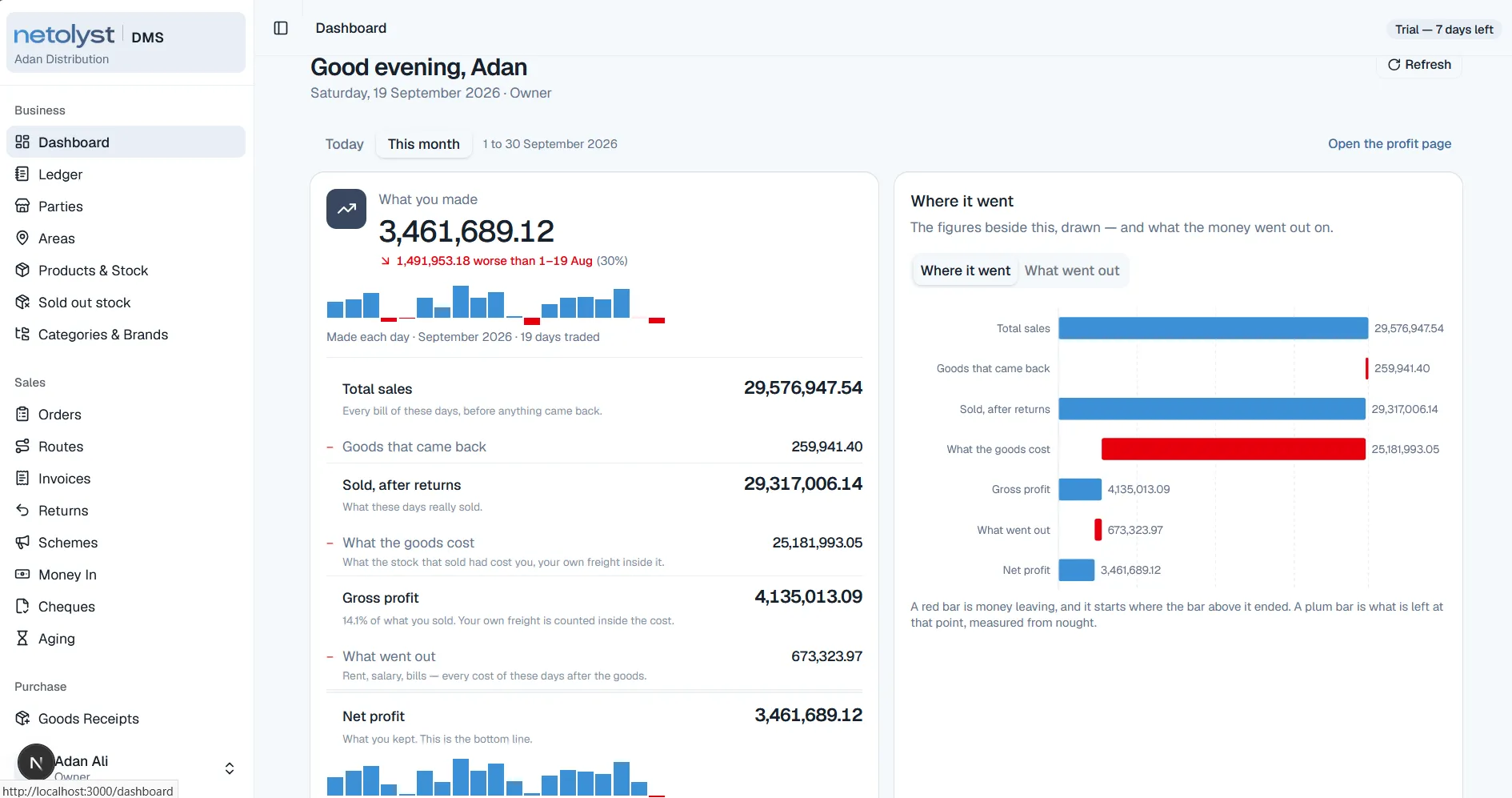
No. The dealer accounts are in the product, and the double-entry accounting writes itself as each document posts. Nothing is exported to an accounting package and nothing is retyped into one. Profit, the balance sheet and the cash flow all read off the same transactions your bills and receipts created.
What does it cost?+
No price is published, because none is set. It is one product with everything in it, priced in Pakistani rupees for a term you choose, with no tiers and no feature gating. A 14-day free trial exists and you can start it yourself, and it gives you a complete working system rather than a sandbox.