Industry · FMCG distribution

FMCG distribution software for Pakistan

Netolyst DMS runs the day of an FMCG distributor in Pakistan: the booker’s round on a phone with no signal, the bill at the counter, the shop’s khata, the stock in the godown, and the books behind all of it. FMCG means fast-moving consumer goods — tea, soap, biscuits, cooking oil, the things a kiryana shop reorders every week.

+92 336 0861999

A FULL DAY, NO INTERNETTHE ROUNDSENDWHEN SIGNAL RETURNSoldest firstTHE OFFICENONE LOSTNONE DOUBLED
A booker’s round taken with the data off, reaching your office one order at a time.

This is Netolyst DMS. There is no FMCG-only version.

Everything on this page is part of Netolyst DMS — one system that takes the booker’s order, cuts the bill, holds the godown, keeps the shop khata and writes the books. There is no FMCG edition and no separate order-booking app to buy. The trade is not a setting in this product; it is the shape the product was built around.

If you want the whole business and not only the FMCG angle, start with the full list of what it does and come back here for the fit.

The fit

Why FMCG is the shape this software was built around.

Fast-moving consumer goods is not a hard trade to describe. You hold the agency of two, three, maybe four companies. You buy in truckloads. You sell in cartons and single pieces to a few hundred small shops. Almost all of it is on credit. And the selling is done on foot, by bookers who walk the same round on the same days every week.

Everything in this software is shaped by that trade. Not adjusted for it afterwards. Shaped by it from the start.

The catalogue is split by company, because one principal’s stock and another’s are two different conversations and two different statements. Stock is held by lot, because the carton you bought in June did not cost what the carton you bought in September cost. The shop’s account behaves like the paper khata, because that is how your shops actually pay you — a round figure, against no particular bill. And the order starts on a phone at the shop’s door, because that is where it really starts.

Each of those four has a page of its own, where the mechanics are explained in full: the round and the order, stock held by lot, the shop khata, the bill itself and the books behind them. This page is about the trade they add up to.

This is not a brand’s distributor-tracking system
Most FMCG field software is bought by a manufacturer who wants to watch its distributors. This one is bought by you, the distribution house. The round, the order, the bill, the khata and the books are all yours, and no principal gets a login into them.
This is not a shop billing program
A billing program knows the rate. It does not know what the carton cost you, which company it belongs to, which round the order came off, or what that shop already owes. Those four are the whole job in this trade.
This is not warehouse software
Warehouse software manages racks, bins and pick paths. Your godown is a rented room with cartons stacked on the floor. Here the place is the godown, and the condition of the goods inside it — saleable, damaged or expired.

The problem

The week this replaces.

A distribution house usually runs on four record books that do not talk to each other, so the same carton gets written down four times. By Thursday the four copies disagree. None of this is anybody’s mistake. It is simply what happens when the order, the bill, the stock and the ledger are four separate books.

  1. The booker’s diary, copied twice

    He walks his round with a diary. He rings the orders in, or sends them on WhatsApp. Somebody at the office copies them onto a bill book. Two of those three writings are copying, and copying is where a carton becomes a piece.

  2. A bill that knows the rate but not the cost

    The order is typed a third time into a billing program that can print a price and cannot tell you what that carton landed at. So nobody at the counter knows whether the sale made money.

  3. The balance in the munshi’s handwriting

    The shop’s account lives in a register only one man can read. When he is on leave, the house does not know what a shop owes, and nobody can check the figure against the bills it came from.

  4. A stock figure from Saturday

    The number everything else depends on is whatever somebody counted at the weekend. By midweek it is a guess, and an order is promised against a guess.

  5. The statement built in Excel the night before

    The company’s area manager arrives and asks for his stock-and-sale statement in his own format. Somebody builds it from the bill book after hours, and builds it slightly differently the next time he visits.

  6. A scheme nobody is still counting

    A letter said twelve cartons earn one free. The counter man remembered it for about a week. The free carton went out, the shop returned eight of the twelve, and nobody worked out that the free one is no longer earned.

Several agencies

Three companies in one house, kept apart without effort.

A house holding several agencies does not want three systems. It also does not want one system that mixes them. Company here is not a tag on a record. It is how the data is built, which is why a figure for one principal can never quietly carry another one’s cartons.

How Netolyst DMS divides a distribution house that holds several principals’ agencies: what the companies share, and what stays apart.
What it isShared or separateWhat that means for you
The catalogueSeparate, by companyEvery product belongs to one company. The same item from two principals is two items, and the two never net into one figure.
The godownShared, one roomCartons of all your companies sit together, because that is how they really sit. You do not have to rent a second godown to get a second statement.
The stock reportSeparate, by companyThough the goods are commingled, they are reported per company: opening, received, sold, returned and closing, in cartons and in rupees.
The shop’s khataOne running account per shopHowever many agencies you hold, a kiryana owner owes your house one figure, because that is the only figure he keeps himself.
What is outstanding for a companyIts own list, read off the billsOne row per bill of the period that carried that company’s goods, with what is still standing on it. That is the per-company view of the market’s debt.
The damage roomIts own godownDamaged, expired and returned goods are kept in a separate godown in the software, because they are kept in a separate room in your building.

How godowns, conditions and the damage room actually work is explained on the inventory page, and how one shop sits on two rounds on the sales page.

The counter

One bill, cut in one action.

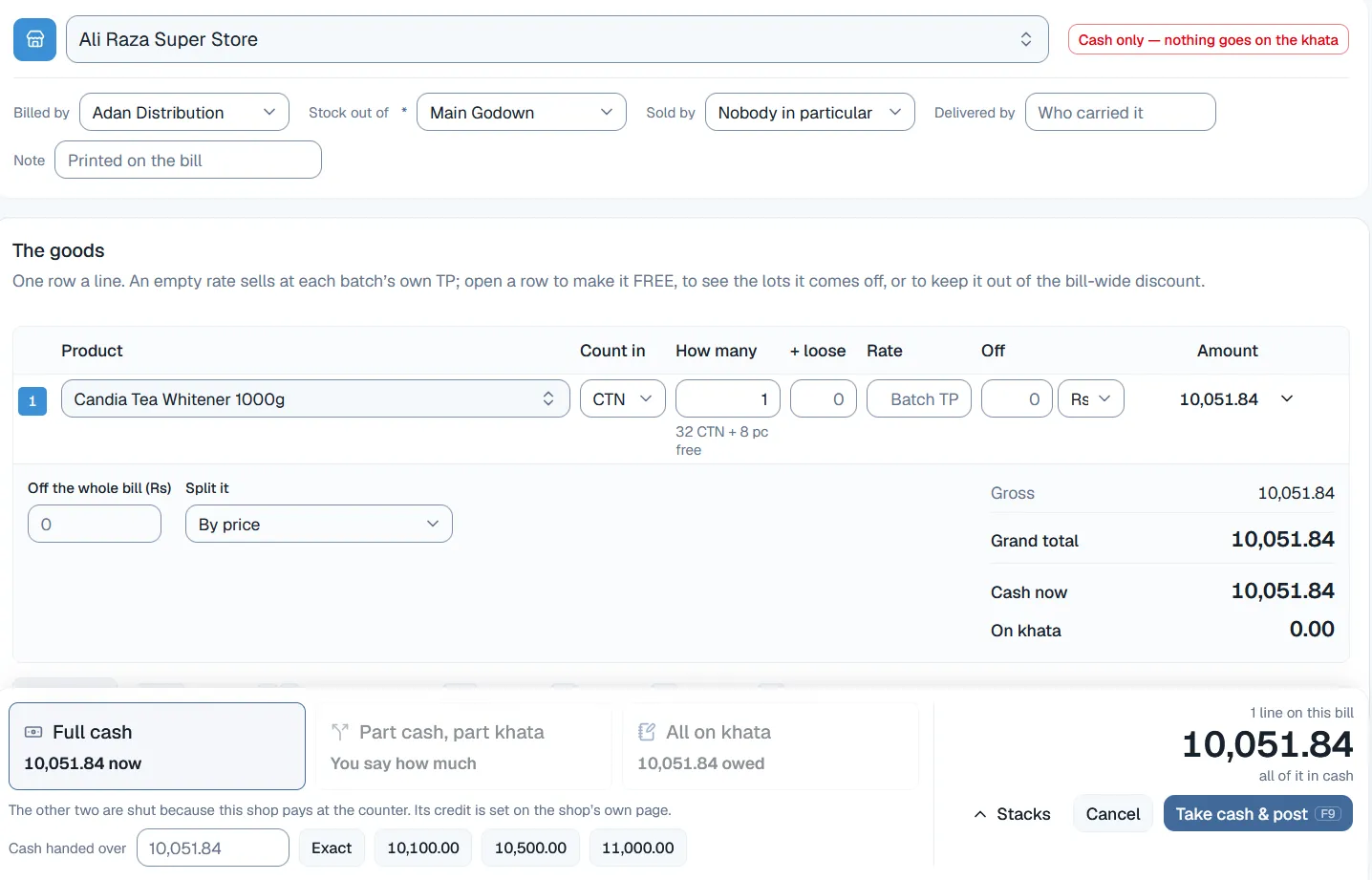
Choose the shop and the bill arranges itself around it. The software picks the lots, oldest first, and puts each lot on its own line with its own rate and its own expiry date — because that is what the shop is actually handed. Taxes and discounts are worked out on the server instead of typed at the counter.

  • The shop’s own rules arrive with the shopA shop marked cash-only closes the credit options at the bottom of the bill. Not because your clerk decided it, but because that shop’s own page says so.
  • A warning before the price goes too lowOne warning when a line falls below that lot’s selling rate. A second, quieter one when it falls below what the carton really cost — and only staff you gave the cost key to ever see that second one.
  • A posted bill is never editedTo correct it you void it, with a reason, and cut a new one. The stock goes back, the khata is credited, and the original stays on the record. That is inconvenient once and right every time after.
  • Every bill records what was actually handed overFull cash, part cash and part khata, or everything on khata. The bottom of the bill shows what came across the counter and what the shop still owes.

One business can also hold several firms, each with its own NTN, its own letterhead and its own bill numbers. They report together and file separately, and bills print on A4 with each firm’s own logo.

The invoice screen in Netolyst DMS: the shop Ali Raza Super Store selected at the top with a red “cash only — nothing goes on the khata” flag beside it, the billing firm and the Main Godown chosen underneath, one product line for Candia Tea Whitener 1000g counted in cartons with “32 CTN + 8 pc free” shown below the quantity, and a footer offering full cash, part cash part khata, or all on khata, where the two credit choices are greyed out because that shop pays at the counter.
The counter · one bill, with the shop’s own rules already applied

The bill has a page of its own: how it is posted, how a wrong one is corrected, and how the three levies are charged. Which lot it takes from, and what that carton cost, is on the inventory page.

Company schemes

The scheme letter applies itself.

A scheme is a company’s trade offer, like twelve cartons earn one free, or a percentage off. You type it in once from the letter: one product, free goods or a percentage, a cap if there is one, how much of it the company is paying for, and the two dates. After that the bill applies it. There is no activate button to forget, because the dates are the status.

Schemes are explained in full on the sales management page, and how a free line appears on the bill on the invoicing page.

How it works

One morning, from the first shop to the books.

These are the real steps in the product, in the order it does them. Between step two and step seven, nobody writes the same carton again.

  1. 01

    Your booker opens his round

    His phone already holds his shops in walking order, what each one owes, what each one bought last time, the catalogue with an indicative rate, and the schemes running now.

    Order booker Android app

  2. 02

    He takes the morning’s orders with the data off

    In a basement, in a mandi, in a shop with three feet of concrete over it. The orders sit on the phone until he taps Send. Nothing is lost if the app is killed, and nothing arrives twice if the signal drops halfway through sending.

    Order booker Android app, offline

  3. 03

    Your office answers each order

    Accepting picks the godown and holds the stock at that moment. Rejecting needs a reason, which your booker reads on his phone. The office has his morning minutes after he sends it, not at lunchtime.

    Order desk Web app

  4. 04

    The bill is cut

    Lots are picked oldest first, each lot its own line with its own rate and expiry, the company scheme applied again on the bill’s own date, taxes and discounts worked out for you.

    Counter clerk Web app

  5. 05

    The goods leave the godown, once

    The bill is the only document that takes saleable stock out, and the free scheme carton comes off the same stock as the paid ones. There is no other screen anywhere that can quietly remove a carton.

    Storekeeper Godown

  6. 06

    The shop pays a round figure

    Against no named bill, the way money really arrives in this trade. The system spreads it over the open bills, oldest first. Nobody has to tag a payment to a bill.

    Cashier Web app

  7. 07

    The books are already written

    Every one of those documents wrote its own double-entry accounting as it posted, in the same action. Nobody types a voucher, and nothing is exported to a second program.

    Accountant Written by the documents

The carton your booker wrote at the shop door in step two is the same carton on the bill in step four, the same carton off your shelf in step five, and the same rupees on the shop’s khata in step six. By the end of that morning the company’s stock-and-sale statement is already built, because it is a sum over the same movements.

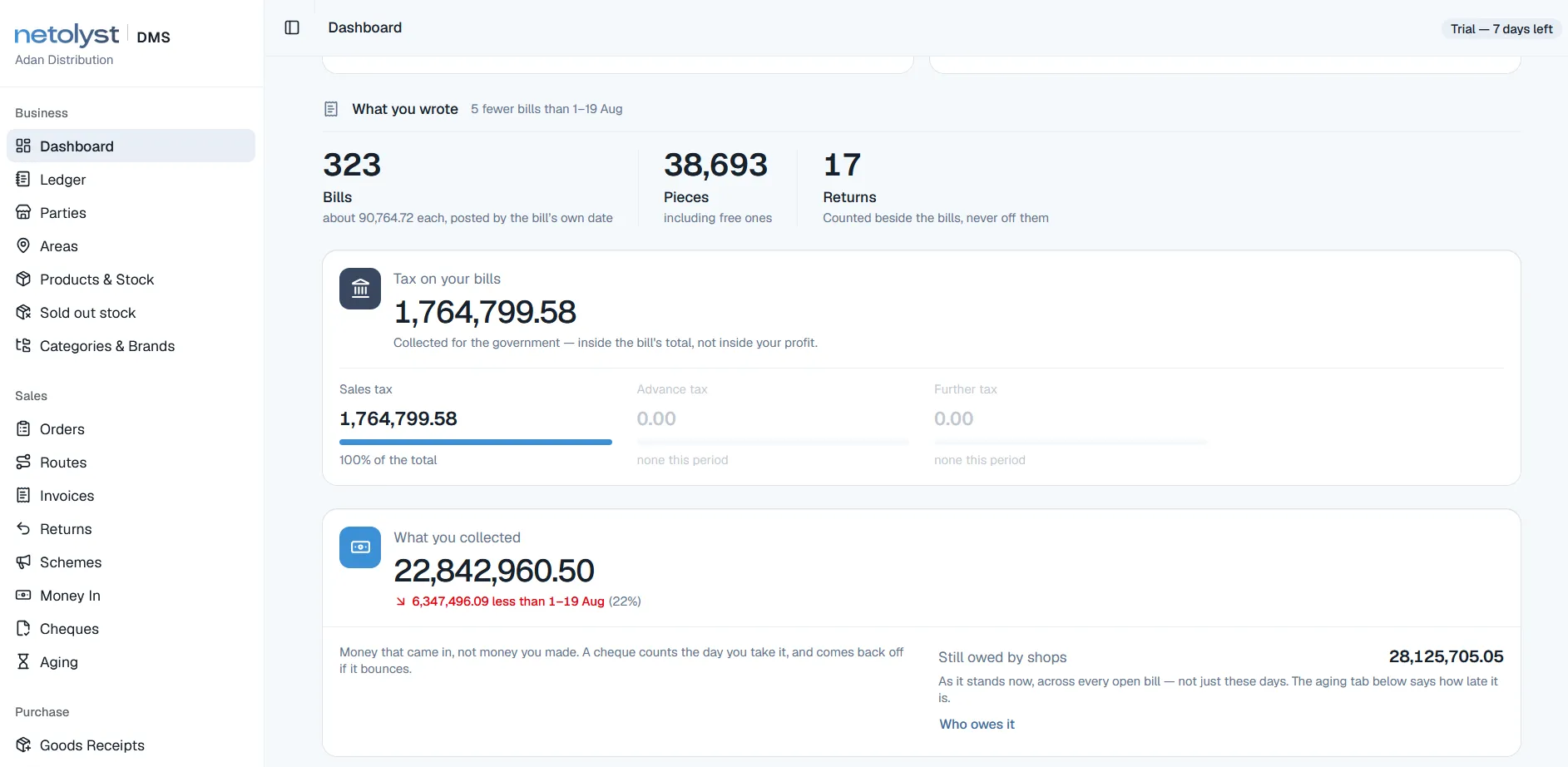
The Netolyst DMS dashboard for a month of trading: bills, pieces and returns counted separately, the tax on those bills split into sales tax, advance tax and further tax, the money collected during the period, and beside it the total still owed by shops across every open bill.
Dashboard · what you collected, and what is still standing in the market

Recovery

What the market owes you, and how old it is.

The receivables ladder — not due, 1–30, 31–60, 61–90, over 90 days — is built from what is left on each bill, not from party totals. A bill of 10,000 with 9,000 paid ages 1,000, which is the honest figure. That is the difference between a recovery list your staff act on and one they ignore.

  • Overdue is worked out the moment you lookNo job has to run at night, so nothing can be a day out of date. A bill that is paid is never shown as overdue, however old it is.
  • Each shop carries its own rulesA credit limit, a number of credit days, and a cap on how many bills can stand open at once. A shop can be marked cash-only, and the selling side then refuses credit for it until somebody with the right key changes that, with a reason.
  • Your booker sees the balance before he takes the orderEach shop on his phone carries what it owes now and what it bought last time. Whether more goods should go out on credit is a question he can answer at the shop door, not after the cartons have left.
  • A balance you give up on goes through its own doorA write-off has its own key and its own reason, and the loss lands in bad debts. It does not quietly shrink last quarter’s sales.

This is also where the principal’s outstanding list comes from. The same unpaid rupees, read off the bills that carried his goods instead of off the shop.

This is a screen from the running product, captured on a demonstration business. The figures in it are demonstration data, not a customer’s books. Collecting the money — receipts, cheques, overdue and aging and write-offs — is explained on the customer ledger page.

The visit

The two pages the company’s man asks for.

He arrives, he inspects the damage room, and he asks for two things. Both are printed and handed over. Neither one is built in Excel the night before.

The rest of the report pack, and how the statements are built, is on the accounting page. What sold, what came back and what is still owed is on the sales reports.

Connected

The parts behind an FMCG distributor’s day.

Nothing on this page is a separate program. These are the six parts of Netolyst DMS an FMCG house uses every day, and each one writes into the next at the moment you save.

The round and the order

A route is one booker’s round: his shops in walking order, his name on it, and the days of the week he walks it. He takes orders on an Android phone with the data off, and your office accepts or rejects each one against a real godown.

Stock, by lot and by godown

Stock is a ledger of movements, not a number somebody edits, so the difference between the book and the floor is always a question with an answer. Each lot keeps its own cost and its own selling rate, and two loads of the same product are never averaged into one blurred figure.

The bill

The only document that takes saleable stock out of your godown, cut in one action, oldest lot first, with taxes and discounts worked out for you. A posted bill is corrected by a void and a fresh bill, never by an edit.

The shop khata

A running account per party, rows added and never edited, each carrying the balance after it. Money arrives as a round figure against no named bill and is spread over the open bills, oldest first. Goods handed back settle a bill the same way money does.

The books

Every money document writes its own double-entry accounting as it posts. The profit page, the balance sheet and the cash flow are sums over the same transactions your house actually did — and the owner’s withdrawals sit in equity, not in expenses.

Who sees the cost

What a carton cost, what the margin is and what the owner withdrew are three separate keys, and none of them comes with seniority. There are 53 named permissions and six roles, and nobody can hand out a key they do not hold themselves.

Five of those six have a page of their own: sales management, inventory management, invoicing, the customer ledger and accounting. The sixth, who may see a cost, runs through all of them.

Limits

What this software does not do.

Worth knowing before a conversation, not after one. The fastest way to waste your time and ours is a demonstration that ends on something the product was never built to do.

Pricing and the 14-day free trial are the same for every part of the product. They are explained on the Netolyst DMS pricing page.

Terms

Trade words used on this page.

These are the words used above, in the meaning the product gives them.

FMCG
Fast-moving consumer goods: tea, soap, biscuits, cooking oil and the rest of what a kiryana shop reorders every week.
Principal
The company whose agency you hold. A house usually holds two to four.
Secondary sale
A sale from you to a retail shop. This is what the software records. A primary sale is the company selling to you.
Booker
The man who walks a fixed round of shops and takes orders. He carries no stock and collects no money.
Route
One booker’s ordered round: the shops in walking order, the man who walks it, and the days of the week it is walked.
Kiryana shop
The small neighbourhood general store you sell to. Hundreds of them, mostly on credit, is the shape of this trade.
Khata
A party’s running account, kept the way the paper register keeps it, where payments arrive as round figures against no particular bill.
Godown
The warehouse. Usually a rented, floor-stacked room with no racking, which is why a distributor needs stock software and not warehouse software.
Damage godown
The separate room where damaged, expired and returned goods are kept, apart from what you can sell — the room the principal’s man walks into and inspects.
Lot / batch
One received consignment of one product, with its own quantity, its own cost and its own selling rate. The same product bought twice is two lots.
Bilty
The goods receipt the transporter gives you. Its charge goes into the cost of the carton along with freight and unloading.
Landed cost
What a carton really cost after freight, bilty and unloading are put into it. This is the number profit reads.
Scheme
A company’s trade offer, like twelve cartons earn one free, or a percentage.
Aging
The receivables ladder: not due, 1–30, 31–60, 61–90, over 90 days.
Stock and sale statement
The per-company statement a principal’s man asks for on a visit: opening, received, sold, returned and closing, in cartons and in rupees.
Mandi
The wholesale market. Named here because it is one of the places a booker’s phone has no signal.

Frequently asked

Questions distributors ask.

Ask us your own question
What is FMCG distribution software?

FMCG distribution software is the system a fast-moving consumer goods distribution house runs its business on: the booker’s round and the orders he takes at the shop door, the stock in the godown held lot by lot, the bill to each kiryana shop, the running khata behind it, and the company schemes the principal funds. It covers what happens after goods reach the distributor and before they reach the shelf, which the trade calls secondary sales. Netolyst DMS is one such system, built in Pakistan for a house holding two to four agencies and billing in rupees.

Can my booker take orders where there is no signal?

Yes. That is what the Android app is for. It holds his round, his shops, their balances, the catalogue and the running schemes from its last download, and takes orders with the mobile data completely off. They wait on the phone until he taps Send. Nothing is lost if the app is killed or the phone restarts, and nothing arrives twice if the network drops halfway through sending. Every figure on his screen shows how old it is, and the app stops taking orders if it falls a week behind.

I hold three agencies. Does it really keep them separate?

Yes, and it is built in rather than tagged on. The catalogue is partitioned by company, so the same product from two principals is two items that never net into one figure. Stock sits together in one godown, which is how it really sits, but reports come out separately. Each company can be handed its own stock-and-sale statement and its own list of what is outstanding in the market on bills that carried its goods.

What does the company’s area manager get when he visits?

Two printed pages and the damage room. The first page is his stock-and-sale statement: per company, per period, opening plus received minus sold minus returned, in cartons and in rupees, built from the stock ledger because what he argues about is cartons. The second is his outstanding in the market: one row per bill of the period that carried his goods, with what is still standing on it. Both come out of the same ledger your house runs on, so nobody assembles them the night before.

Does the principal get a login into my system?

No. The principal’s area manager is not a user and has no account. He is handed a printed statement and a printed list. Your shops, your rates, your margins and your khata stay inside your house. This matters because most field software in this trade is bought by a brand and handed to its distributors — this one is bought by the distributor.

Do I still need a separate accounting program?

No. The khata is in the product, and every money document writes its accounting as it posts, in the same action. The profit page, the balance sheet and the cash flow come out of the same transactions your business actually did. Nobody types a voucher, nothing is exported and nothing is retyped.

What happens if a bill is wrong?

You void it with a reason and cut a new one, which can be filled in from the old one. The stock goes back, the shop’s khata is credited, and the original stays on the record. A posted bill can never be quietly edited. That is inconvenient once and right every time after.

A shop returns cartons it got free goods on. What happens?

The return takes the free goods back, because those cartons no longer earn them. If the shop would be left holding more free goods than it still earns, the return is refused, unless somebody with the scheme key waives it with a reason. The schemes report is then net of returns, so you never claim a carton from a company that has already come home to you.

How do I know what I gave away in free goods this month?

One report shows every scheme over the period with what it actually gave, counting what went out on posted bills minus what came back on returns. Under it sits a no-scheme row, holding the free goods somebody handed over as a favour that no company ever promised. That is where giveaway finally gets a number. Note that turning this into the claim file you send the principal is not built yet.

Does it handle delivery and cash collection at the shop door?

Not today. The bill is cut at the office. There is no van stock, no load sheet, and no app for the supplyman to collect cash against at the door. A bill can record that it was settled in cash, fully or partly, when it is entered, but the delivery run itself is not managed here. If your business is mainly ready-stock van selling rather than book-and-supply, this is not the right product for you yet.

Is FBR digital invoicing connected?

No. There is no live link, no IRN and no QR code on the bill. What exists is a setting on each product recording which ones it will apply to when the link is built, and tax is charged and printed on our own invoice in the meantime. No date is committed for this, and nobody should buy on the expectation of it.

Does it work on a cheap phone?

It runs on Android 7.0 and above, which covers the handsets field staff actually carry. The field app is a small download and is built for one booker signed in at a time. Your office side runs in a normal browser on a laptop or a desktop.

Is it in Urdu?

The screens are in English today. Shop names and owner names are stored and shown in Urdu where that is how they are written, on their own right-to-left line. The English on every screen is written in plain trade words, not software English.

What does it cost?

No price is published, because none is set yet. The shape is decided: one product with everything in it, priced in rupees for a term you choose — monthly, half-yearly or yearly — with no tiers and no features locked behind a higher price. A 14-day free trial exists and you can start it yourself. For a figure, talk to us.

Talk to us

Bring us one round and one godown.

Tell us how many shops, how many companies and how many bookers you have. You will hear back from the people who built it, not a sales desk.

Built for a distribution house in Pakistan holding one to four agencies and billing in rupees. Not for a brand rolling software out across its distributor network, and not for logistics or freight.

Let’s connect